

Imagine one of those places on Earth where you can literally step back in time. Exploring Iceland in winter feels like you’re about to meet woolly mammoths and rhinoceroses at every turn!
It is a land shaped by forces that are difficult to imagine until you see them up close. Fire rises from beneath the earth, rivers cut through valleys, waves carve black coastlines… and above it all, enormous bodies of ice slowly move across the landscape.
Today, glaciers cover around 11% of Iceland. The largest, Vatnajökull, stretches across thousands of square kilometres in the southeast, while Langjökull, Hofsjökull and Mýrdalsjökull create vast frozen landscapes elsewhere in the country. Together, Iceland’s glaciers store an extraordinary amount of freshwater and continue to shape the land around them.
But a glacier is much more than a beautiful white mountain in the distance. It is ice in motion – a slow geological force capable of carving valleys, transporting rock, feeding rivers, creating lagoons and leaving traces of Iceland’s volcanic past inside the ice itself.
Once you understand that, Iceland’s glaciers begin to look very different.
How glaciers form in Iceland
A glacier begins with something remarkably ordinary: snow.
In places where more snow accumulates during winter than disappears during the warmer months, layer after layer builds up. The weight of new snow compresses the layers underneath, squeezing out air and gradually transforming loose snow into dense glacial ice.
Once enough ice has accumulated, gravity takes over. The mass begins to deform and flow downhill, slowly moving from higher areas towards lower ground. This is the fundamental difference between a glacier and an ordinary patch of permanent snow: a glacier moves.
Most Icelandic glaciers are temperate glaciers. Their ice is relatively close to its melting point and can contain water within and beneath it, allowing the glacier to deform and slide as it travels through the landscape. Over years, centuries and millennia, that slow movement becomes enormously powerful. Glacial ice can grind against the bedrock beneath it, carry boulders and sediment and deepen existing valleys.
Much of the terrain that feels quintessentially Icelandic today has been influenced by this long “conversation” between ice and rock. And there is another important detail: a glacier is constantly balancing what it gains against what it loses. Snow accumulating in the upper part of the glacier adds mass, while melting, evaporation and ice loss lower down remove it.
When the balance shifts towards loss, the glacier becomes thinner and its margin retreats.
Ice caps and the rivers of ice beneath them
One of the most useful things to understand about Iceland’s glaciers is that what looks like one enormous glacier from a distance may actually be a vast ice cap feeding many separate tongues of ice.
Ice caps cover broad areas of high ground, while outlet glaciers flow outwards from them through valleys and towards lower elevations. Think of the ice cap as a huge frozen reservoir, with rivers of ice branching away from it.
Vatnajökull is the most spectacular example. Its enormous ice cap feeds numerous outlet glaciers across southeastern Iceland, each responding to the shape of the terrain and the conditions around it.
Langjökull, meanwhile, is Iceland’s second-largest ice cap and one of the country’s most accessible major glaciers. Its broad surface covers roughly 900 km², making it possible to experience a genuine glacier landscape without travelling deep into Iceland’s most remote interior.
The Icelandic word jökull simply means glacier. Once you know it, Icelandic place names begin to reveal something about the landscape itself: Sólheimajökull, Mýrdalsjökull, Langjökull, Vatnajökull. The map is full of reminders that ice is not a side character here.
Vatnajökull: where ice meets fire
If one glacier captures the scale of Iceland’s frozen world, it is Vatnajökull.
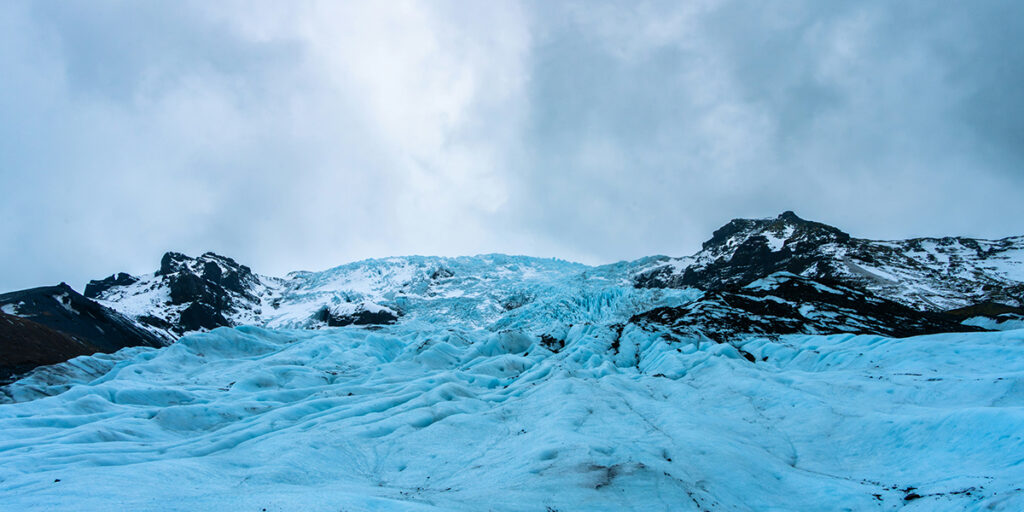
Vatnajökull covers roughly 7,900 km² and stores an extraordinary volume of ice. It is often described as Europe’s largest glacier, although a larger ice cap exists on Severny Island in Russia’s Novaya Zemlya archipelago. What makes Vatnajökull especially fascinating is not simply its size, but what lies beneath it.
Several active volcanic systems lie beneath and around the ice cap. Here, Iceland’s famous relationship between fire and ice is not just a poetic description – it becomes a physical reality. Volcanic heat can melt ice from below, sometimes producing enormous quantities of water. In certain circumstances, that water can escape suddenly in a powerful glacial flood known as a jökulhlaup.
The other side of this story is quieter but just as important. Iceland’s glaciers are the source of all its major rivers, and glacier meltwater accounts for roughly a third of the water flowing from Iceland into the ocean each year. So the next time you see an Icelandic river rushing towards the sea, there is a good chance that part of its journey began as snow high on a glacier.
From glacier to lagoon: the journey of the ice
Perhaps nowhere is the movement of Iceland’s glaciers easier to understand than at Jökulsárlón Glacier Lagoon.
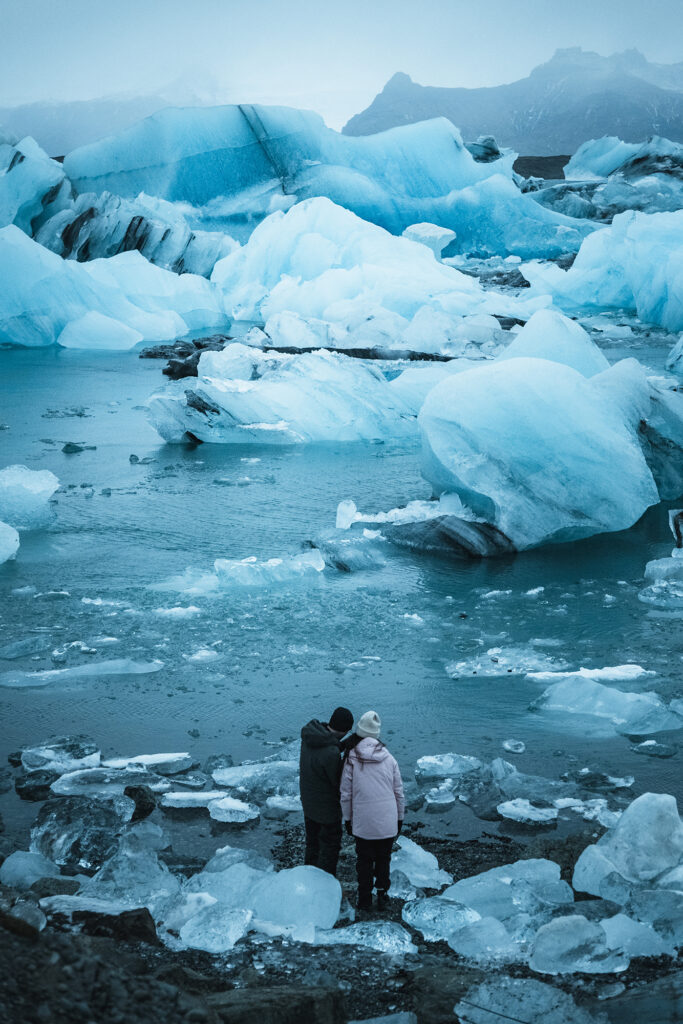
The lagoon is surprisingly young by geological standards. It began forming in the twentieth century as Breiðamerkurjökull, an outlet glacier of Vatnajökull, retreated and left a growing depression that gradually filled with meltwater. Today, enormous pieces of ice break away from the glacier and drift across the lagoon before eventually making their way towards the ocean.
That process is called calving: pieces of glacier ice break away from the glacier front and become icebergs. At Jökulsárlón, you can quite literally watch the glacier feeding the lagoon.
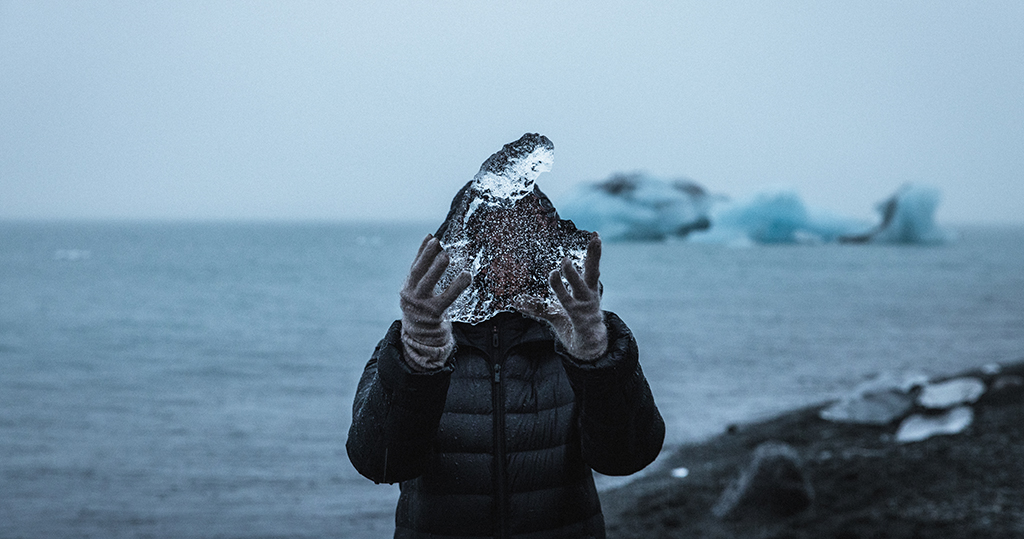
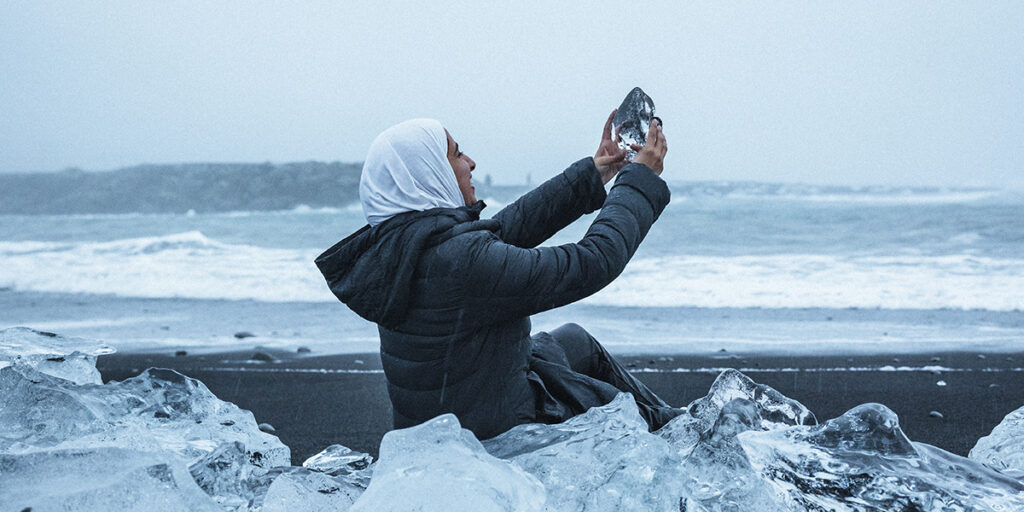
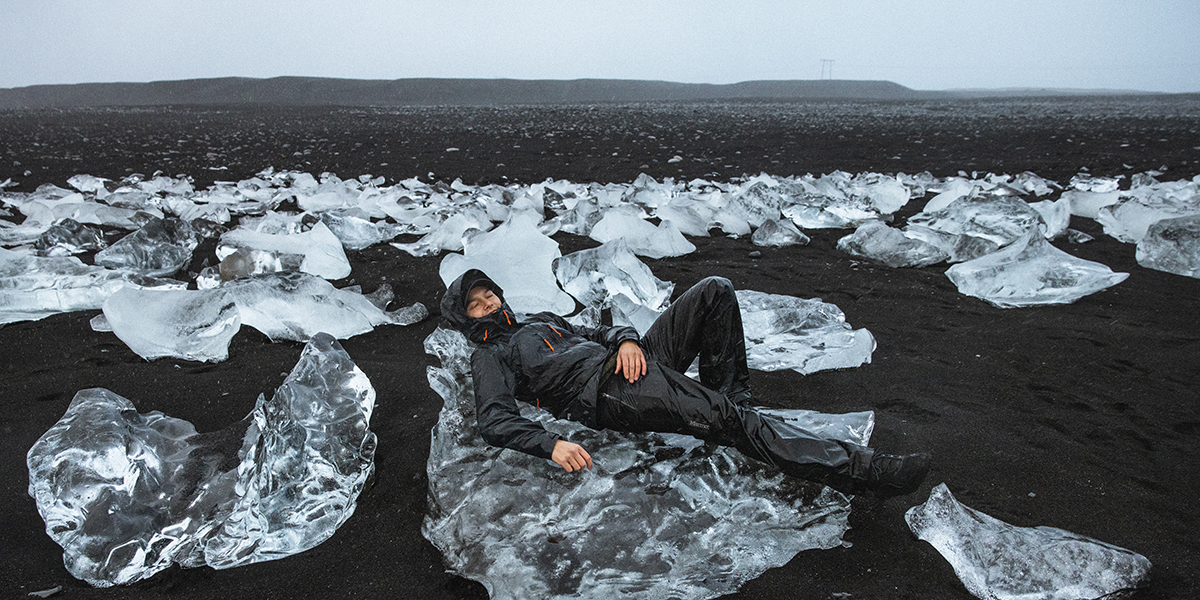
Some of those ice fragments eventually pass out towards the Atlantic. Others are pushed back onto the nearby shore, where they lie scattered across the black volcanic sand of Diamond Beach.
It creates one of Iceland’s most beautiful visual contrasts: ancient-looking pieces of ice glowing in the light against sand formed by volcanic forces.
A piece of ice on the beach may therefore have travelled an extraordinary journey – from snow falling high on Vatnajökull, through years of accumulation and compression, down an outlet glacier, into a lagoon and finally towards the sea.
Why glacier ice can be so intensely blue
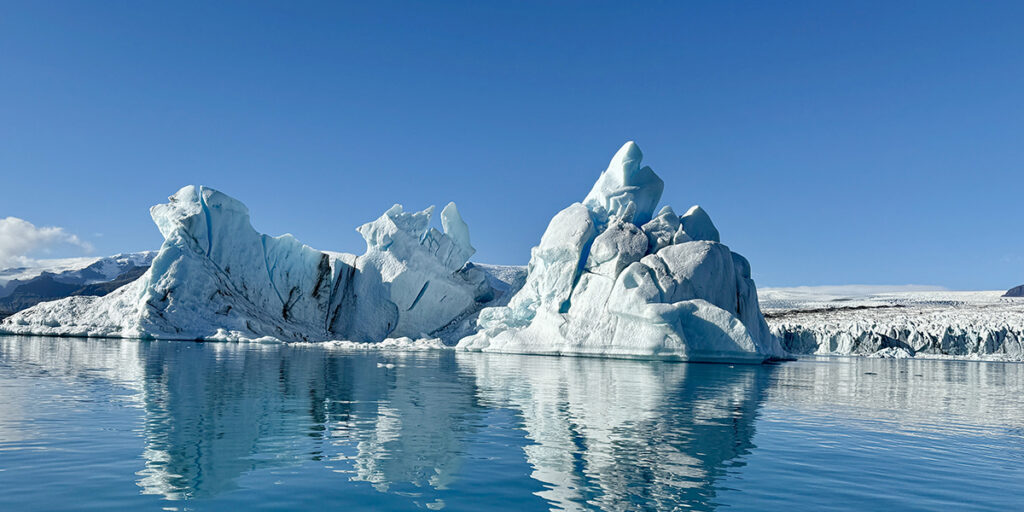
Few things in Iceland look quite as improbable as a wall of deep blue glacier ice.
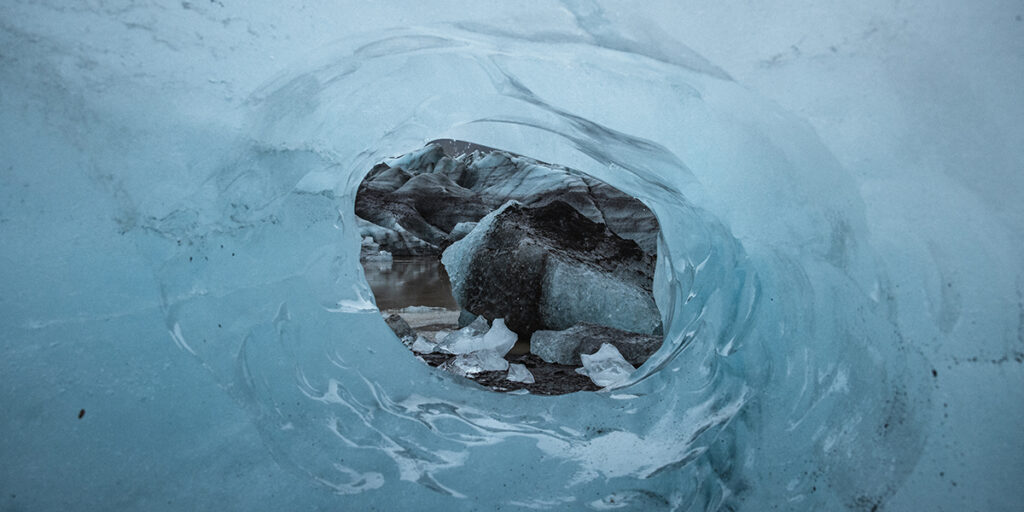
The explanation begins with air. Fresh snow contains plenty of tiny spaces between its crystals, which scatter light in many directions and make the snow appear white. As snow is buried and compressed year after year, much of that air is squeezed out. The ice becomes denser and increasingly transparent.
Dense ice absorbs more of the longer wavelengths of visible light, while more blue light is scattered back towards the eye. The result can be an extraordinary blue colour, particularly in older, compacted ice.
But glacier ice is not always blue. It can appear white, turquoise, grey or almost black depending on its density, lighting, snow cover and the material trapped within it.
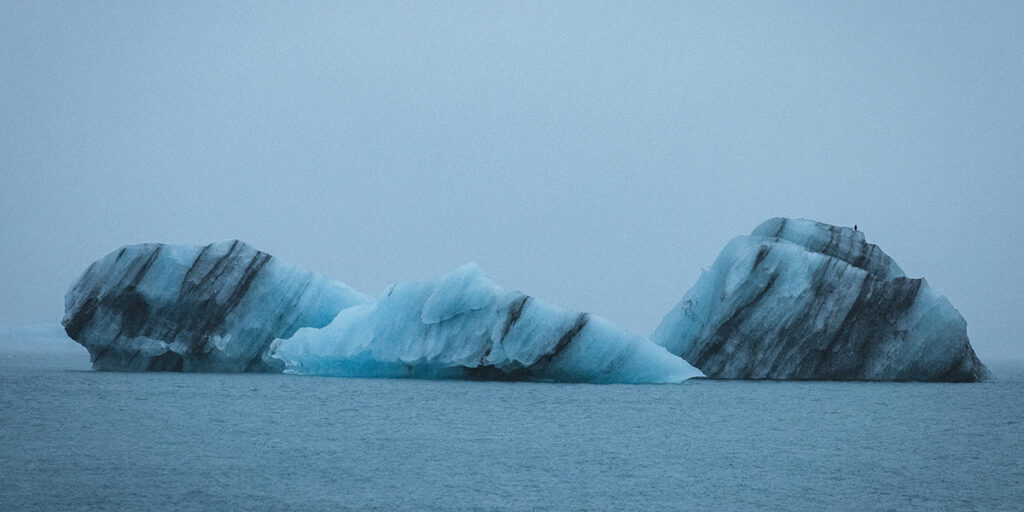
Volcanic ash can become buried within layers of snow and ice, leaving dark bands that preserve evidence of eruptions from the past. In Iceland, even the ice can carry a geological memory of the volcanoes around it.
Iceland’s glaciers are changing
There is another part of the glacier story that matters just as much as their size and beauty: Iceland’s glaciers are changing.
All of Iceland’s ice caps have retreated and thinned considerably since the end of the Little Ice Age in the nineteenth century. Since the mid-1990s, the pace of retreat has become particularly rapid as the climate has warmed.
The change is not simply a line on a scientific graph. It alters the landscape itself. As ice retreats, new ground is exposed, lakes can form at glacier margins and rivers may change their courses. The landscapes photographed by travellers today are not necessarily the landscapes that will exist in the same form decades from now.
Vatnajökull itself has lost a significant amount of ice over the past century, while its southern outlet glaciers have been retreating and thinning particularly rapidly. The glacier landscape is therefore not something frozen in a permanent state. It is a record of changing conditions.
That also matters when visiting. Glacier margins are dynamic environments. Crevasses, unstable ice, rockfall and rapidly changing conditions can make apparently simple terrain hazardous. In July 2026, the Icelandic Meteorological Office highlighted changing conditions and rockfall risk around Sólheimajökull, a useful reminder that the glacier you see on a photograph is not necessarily the glacier you will encounter months later.
For that reason, glacier hikes and ice-cave visits should always be undertaken with appropriate equipment and qualified guides who can assess current conditions.
Experiencing a glacier rather than simply seeing one
You do not have to be an experienced mountaineer to experience Iceland’s world of ice. Some glaciers can be admired from viewpoints or approached on foot, while guided experiences allow visitors to walk on the ice, explore naturally formed ice caves or travel into the heart of a glacier.
The difference between seeing a glacier from a distance and standing beside one is surprisingly profound. You notice the layers in the ice, the dark sediment carried across its surface, the sound of meltwater and the sheer scale of the ice in front of you.
And suddenly all those facts become tangible. The glacier is no longer simply “a glacier”. You can see that it moves, melts, carries rock, stores water and interacts with everything around it.
Inside Langjökull: the Into the Glacier experience
There is one particularly unusual way to experience Iceland’s ice: going inside it!
On our Silver Circle & Glacier Exploration tour, the journey through West Iceland continues towards Langjökull, where guests can enter the Into the Glacier ice tunnel, a man-made tunnel carved deep into the ice.
It creates one of those wonderfully Icelandic contrasts that is difficult to plan on paper. Earlier in the day, you might be standing beside the steaming waters of Deildartunguhver; later, you are surrounded by dense blue-white ice beneath Langjökull. Can you imagine a more beautiful way of exploring Iceland’s winter landscapes and fascinating geological history?
The tour is private for up to four guests, with a local certified guide, experienced driver and professional photographer. Along the way, it combines Langjökull with Reykholt, Deildartunguhver, Hraunfossar and Barnafoss, making the glacier part of a wider story about the geology and culture of West Iceland.
There is more than one way to explore Iceland’s glaciers
For travellers who want to experience the ice as part of a classic Iceland day, our Golden Circle & Langjökull Glacier Tour combines Þingvellir, Geysir and Gullfoss with the dramatic landscapes of Langjökull. It is a natural choice if you want to see the country’s most famous sights while adding a very different kind of landscape to the day.
If walking directly on the ice is what appeals to you, our South Coast & Glacier Hike includes a guided glacier walk on Sólheimajökull. The overall tour is private, while the glacier walk itself is operated as a joining group with qualified glacier guides and the necessary safety equipment.
And for travellers visiting in winter, the 2-Day Glacier Lagoon & Ice Cave Tour follows the South Coast towards Vatnajökull, Jökulsárlón and Diamond Beach before continuing into a naturally formed blue ice cave. The overall journey is private, while the ice-cave and glacier experience is operated in a small joining group with trusted local partners.
The important thing is that there is no single “best” way to experience a glacier. For some travellers, the fascination is simply seeing the enormous ice cap in the distance. For others, it is walking across ancient ice, stepping into a blue cave or following an iceberg’s journey to the sea.
No matter what way you choose, make Icelandic Roamers your guides and travel companions to make the most of yoru glacial adventures. We bet you won’t be disappointed! 🙂
A country shaped by ice
It is easy to think of glaciers as something distant: white mountains sitting quietly on the horizon.
But Iceland’s glaciers are woven into the landscape in almost every direction. They carve and reshape the land, feed its rivers, interact with its volcanoes, create lagoons and carry traces of geological history within their ice.
They are also changing, which makes every encounter with them feel a little more significant. The glacier in front of you is part of a landscape that is still being written.
Perhaps that is what makes Iceland’s glaciers so fascinating.
They may look frozen in time, but they never really are.